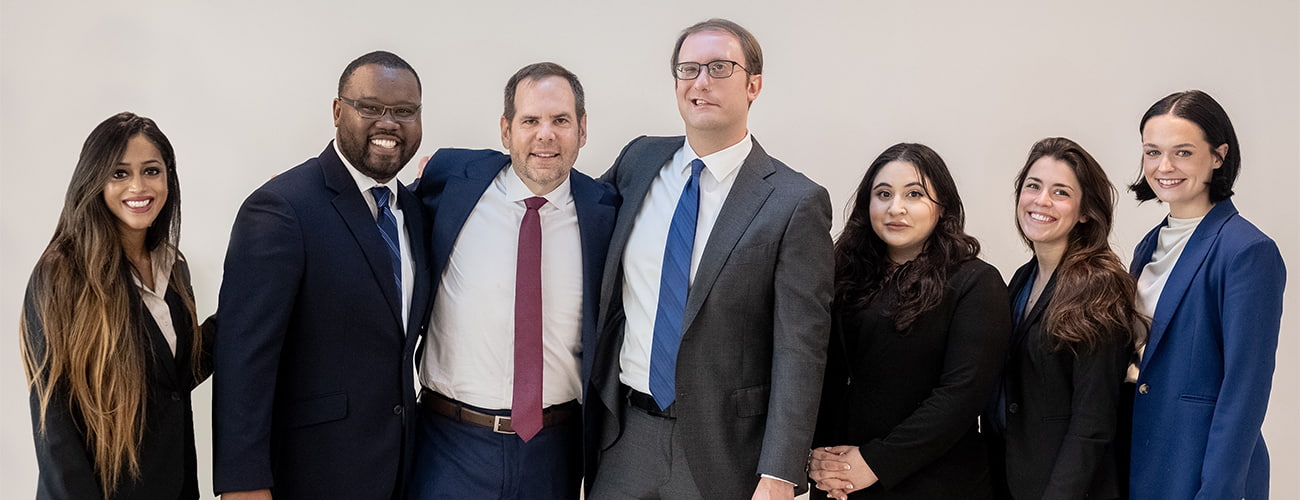
Celebrating 25 years of representing Dallas employees are Rachel Bethel, Deontae Wherry, Rob Wiley, Harjeen Zibari and Riley Carter (from left to right).

Neil M. Gorsuch has recently become the 113th justice of the United States Supreme Court. Republicans had refused to consider President Obama’s Supreme Court nominee, Judge Merrick Garland, claiming that the choice of a justice to replace Justice Antonin Scalia should belong to the president who succeeded Obama. Once Democrats filibustered, they altered the Senate rules in order to push Judge Gorsuch through. Appointed by President Trump and aggressively pushed through the confirmation process, Judge Gorsuch may be able to serve on the Court for 30 or more years and is likely to leave a lasting impression on the Court’s jurisprudence.

The confirmation is a potential disaster for workers’ rights. Although Judge Gorsuch is a highly esteemed judge, his past decisions show far more sympathy for corporations than their employees. He is highly likely to rule in a similar fashion in the future, although there have been Supreme Court justices in the past whose views shifted once they were on the bench.

Judge Gorsuch’s decisions during his decade-long tenure on the United States Court of Appeals for the 10th Circuit have shown he believes that corporations should have the same rights of religious freedom and free speech as people. This approach—placing corporations on the same playing field as human beings—has helped big business in the past and evinces little concern for workers and their lives.

Continue reading ›

The Texas Minimum Wage Act establishes minimum wage for nonexempt employees in Texas. It has adopted the federal minimum wage, and currently minimum wage is $7.25 an hour. This is too low for anybody to live on, and it is shocking when you consider how much exempt employees such as CEOs of corporations and professionals can make. Since the federal minimum wage hasn’t been changed since 2009, it has not kept pace with inflation, and what that $7.25 minimum wage represents is much less than what it previously meant.

The Texas Minimum Wage Act also provides for agricultural piece rate workers, exempts certain employers, allows employers to count trips and the value of meals and lodging toward their employees’ minimum wage, and specifies civil remedies for violations.

With specified restrictions, employers may use an employee’s tips and the value of meals and lodging toward the minimum wage that must be paid. The law also specifies that those who live at the job site for on-call time do not need to be paid in addition to their assigned working time. Certain other employees who have productivity impairments, have mental health or development problems, or are of a certain age may also be paid sub-minimum wage.

Continue reading ›

Before minimum wage and overtime were instituted, the average American worker worked brutal hours. Workers were easily exploited by their wealthier employers, which forced them to work around the clock just to be able to survive, living paycheck to paycheck and not making much more than what it took to feed their families.

In 1938, President Franklin D. Roosevelt signed a number of bills, one of which was the Fair Labor Standards Act of 1938 (FLSA). The FLSA applied to industries that together held about one-fifth of the labor force, and, among other things, it set a minimum wage at 25 cents for those industries.

Importantly, it also introduced overtime regulations that guaranteed all nonexempt workers be paid time and a half for hours worked over 40 hours a week. These rules were intended to address the exploitation of workers and the lack of jobs.

Continue reading ›

Contact Information