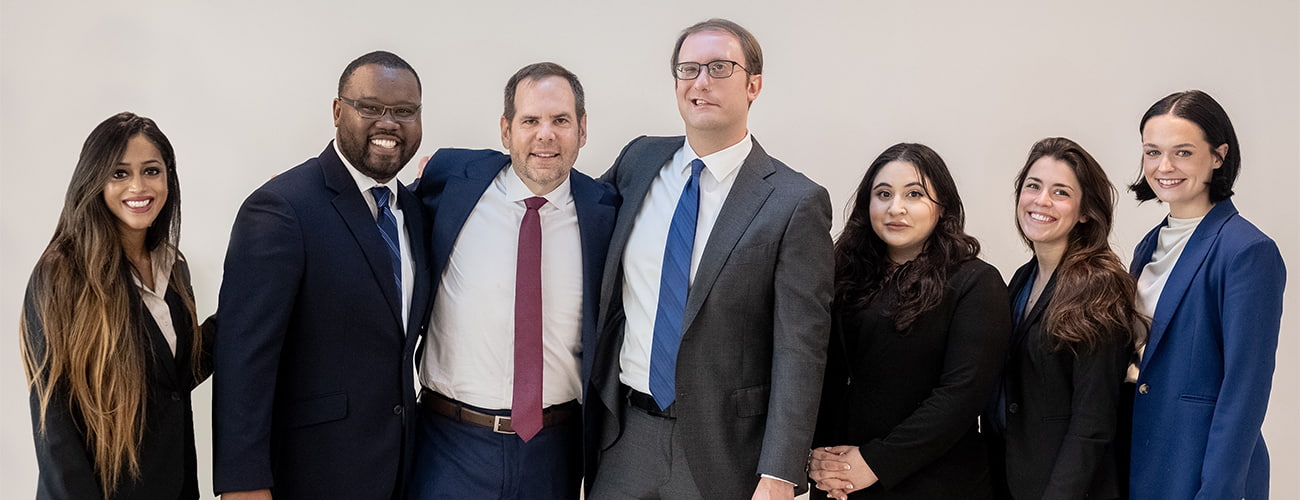
Celebrating 25 years of representing Dallas employees are Rachel Bethel, Deontae Wherry, Rob Wiley, Austin Campbell, Harjeen Zibari, Riley Carter and Ellen Johnston (from left to right).

Austin Campbell

Dallas Employment Trial Lawyer Austin Campbell

On August 19, 2025, the Fifth Circuit Court of Appeals, which is the federal appellate court over Texas, ruled that the National Labor Relations Board—the independent federal agency that oversees union elections and protects the rights of workers to organize and discuss the terms and conditions of their employment—was structured in an unconstitutional way. The decision is SpaceX et al. v. National Labor Relations Board, No. 24-50627. This decision is all but guaranteed to lead to a showdown at the U.S. Supreme Court, where it could potentially upend massive amounts of rulings both by courts and the NLRB itself, as that agency has been around for nearly 100 years.

The NLRB employs a number of Administrative Law Judges to decide “unfair labor practice” cases before the Board. These are not “Article III” federal judges like the ones who decided this case, but employees of the Board who decide disputes that are filed with the Board. This is not an uncommon structure in how federal agencies work. For instance, all of the immigration judges who have been in the news lately deciding whether to deport asylum seekers are so-called “Administrative Judges,” a slightly different category.


Riley Carter

Dallas Employment Trial Lawyer Riley Carter

The PUMP Act, short for Providing Urgent Maternal Protections for Nursing Mothers Act, represents an important step forward in workplace protections for nursing employees. Signed into law in December 2022, the Act significantly expands and strengthens the rights of breastfeeding workers in the United States. Below, we’ll walk through the history of the law, the protections it provides, its limitations, and what employees should know about exercising their rights under it.

The History Behind the PUMP Act

Rachel-Bethel-200x300

Rachel Bethel – Trial Attorney

Workplace issues can start subtly: a passive-aggressive comment, a suspicious change in workload, or a shift in how management treats you. Many employees hope these problems will work themselves out or go away eventually. However, waiting too long to get legal guidance can make things worse & potentially limit your options later on.

Whether you’re facing discrimination, retaliation, or a hostile work environment, speaking with an employment attorney early in the process can be one of the smartest moves you make.

Harjeen Zibari

Dallas Employment Trial Lawyer Harjeen Zibari

Oftentimes, workers will come to me insisting that they have the evidence that will definitively prove their case: a recording. However, this can open a whole other can of worms that the worker did not even anticipate, and sometimes, that recording becomes more trouble than it’s worth.

In today’s workplace, it’s easier than ever to hit “record” on your phone when a meeting or conversation is happening. Some employees think of recording as a way to protect themselves—especially if they suspect harassment, discrimination, or unfair treatment. But before you press record, it’s important to understand that recording conversations at work can be legally risky.

Ellen Johnston

Dallas Employment Trail Lawyer Ellie Johnston

Every employee deserves a safe workplace. Whether you work in construction, health care, retail, or an office, your employer has a legal duty to provide an environment free from known hazards. The Occupational Safety and Health Administration (OSHA) was created to enforce these rules and protect employees when companies cut corners. But too often, workers hesitate to speak up because they fear retaliation.

The truth is that retaliation is common—and it’s illegal. Workers who raise safety concerns, request inspections, or file OSHA complaints are protected by federal law. Retaliation can take many forms: sudden termination, reduced hours, demotion, harassment, or even blacklisting that makes it harder to find work in the future. These actions are meant to intimidate, but OSHA’s whistleblower provisions exist precisely to stop employers from silencing their workers.

Deontae Wherry

Dallas Employment Trial Lawyer Deontae Wherry

Picture this: you are at work when someone hands you a subpoena. You did not ask for it, and maybe you do not even want to be involved, but now you are legally required to show up in court or provide documents. You want to do the right thing, so you comply with the subpoena. But when you get back to work, your boss is not happy. Maybe he/she cut your hours, your responsibilities change, or, worst of all, he/she terminates your job.

If that sounds unfair, that’s because it is. And, in Texas, it is also illegal.

Just at the start of September 2025, two different Texas public universities have fired professors as a result of their speech.  Texas State University explicitly fired Professor Thomas Alter because of a speech he gave at a conference of socialists, and Texas A&M University fired Professor Melissa McCoul after a student, in a controversial viral video, confronted her about what she was supposedly teaching about gender in her classroom.  While both of these events just happened and it is hard to say what might eventually become of these cases, they each appear to set up a possible confrontation between the universities and their professors’ regarding free speech rights.

And there have been many such confrontations in recent years.  In July and August 2025, for instance, the Third Circuit and Seventh Circuit Courts of Appeals each issued decisions addressing whether schools and universities could legally fire some employees over their (politically right wing) speech.  The point of this article isn’t to dissect these any of those cases—much less the merits of the underlying speech—but to discuss what legal standard courts in the Fifth Circuit (which includes Texas) might apply should disputes over these sorts of terminations go forward.

The First Amendment prevents federal and state governments from infringing on the rights of people to engage in free speech, but that is not an absolute right.  Nonetheless, public employees are protected against termination for engaging in speech protected by the First Amendment.  The standard for this has been set out by the U.S. Supreme Court in a number of cases.  To prove that their speech was protected, the public employee must show that they spoke (1) as a citizen (2) on a matter of public concern, and that (3) the public employer did not otherwise have an adequate justification for treating the public employee differently than any other member of the public saying the same thing.

Ellen Johnston

Dallas Employment Trail Lawyer Ellie Johnston

Coming out of the Fourth of July, I’ve been thinking about the disconnect between how we celebrate veterans publicly and how many are treated at work. In my practice, I’ve represented disabled veterans who faced discrimination, retaliation, or termination after simply asking for the accommodations they needed to do their jobs.

Returning to the civilian workforce as a veteran comes with challenges. For disabled veterans in particular, the transition can be even harder when an employer treats your request for support like a burden—or worse, a threat.

Cassidy Monska

Dallas Employment Trial Lawyer Cassidy Monska

Retaliation is one of the most frequently alleged forms of workplace misconduct in Texas. Although the law protects employees who assert their rights, many still face adverse consequences after reporting discrimination, requesting accommodations, or participating in investigations. Unfortunately, retaliation can be subtle, delayed, or disguised as ordinary business decisions.

What Is Workplace Retaliation?

Rob Wiley

Dallas Employment Trial Lawyer Rob Wiley

On May 15, 2025 a conservative judge struck down federal guidance protecting gay and transgender employees from discrimination and harassment in the workplace.  This is not normal or business as usual, this is a sledgehammer-style legal assault on our community.  Judge Matthew J. Kacsmaryk’s opinion undoes decades of progress, declaring it legal to harass and bully workers who happen to be gay or trans.  As a gay employment lawyer, I want to address what this means for us.

Employment discrimination against gay and trans people is real.  We all have to have a job, and it’s all too common to have a co-worker or manager who resents having to work with someone who is gay or trans.  That’s why this decision hits hard, it’s going to have a real impact on real life.

Contact Information